
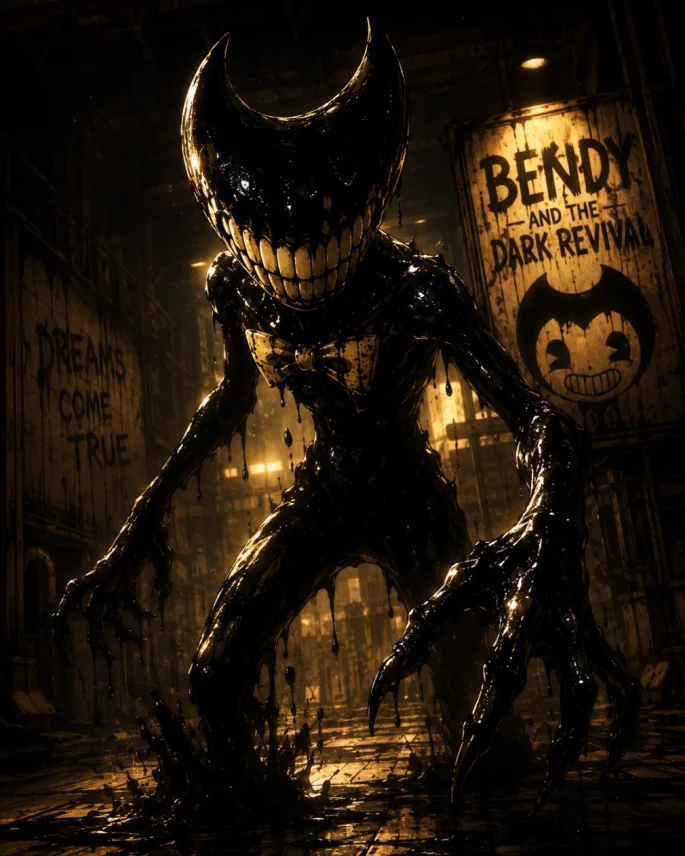
When Bendy and the Ink Machine debuted in 2017, it fundamentally shifted the landscape of indie survival horror. By blending the charming aesthetic of 1930s rubber-hose animation with a sinister, ink-drenched narrative, it captured a massive global audience.
With the launch of the highly anticipated sequel, Bendy and the Dark Revival, the franchise significantly expanded its world-building, narrative maturity, and environmental scale. At the epicenter of this psychological nightmare is the terrifying evolution of the bendy and the dark revival ink demon character, who returns with a grotesque new form, an expanded voice, and an absolute grip over the cartoon realm.
This comprehensive guide breaks down the complex lore of Joey Drew Studios, evaluates the mechanical evolution of the gameplay, and examines what makes this entity a modern horror icon.
The Narrative & Lore Evolution of the Fiend
While the original game felt like an episodic puzzle piece, the sequel delivers a fully realized, continuous cinematic narrative.
The Journey of Audrey
The story shifts focus to a fresh protagonist, Audrey, an animator working at the desolate Joey Drew Studios. Thrusting Audrey into a nightmarish, ink-diluted reality, dark entities reveal that she is not merely a passive observer but a central figure whose past they have intrinsically bound to their rule of the studio.
The True Legacy of the Dark Revival Ink Demon
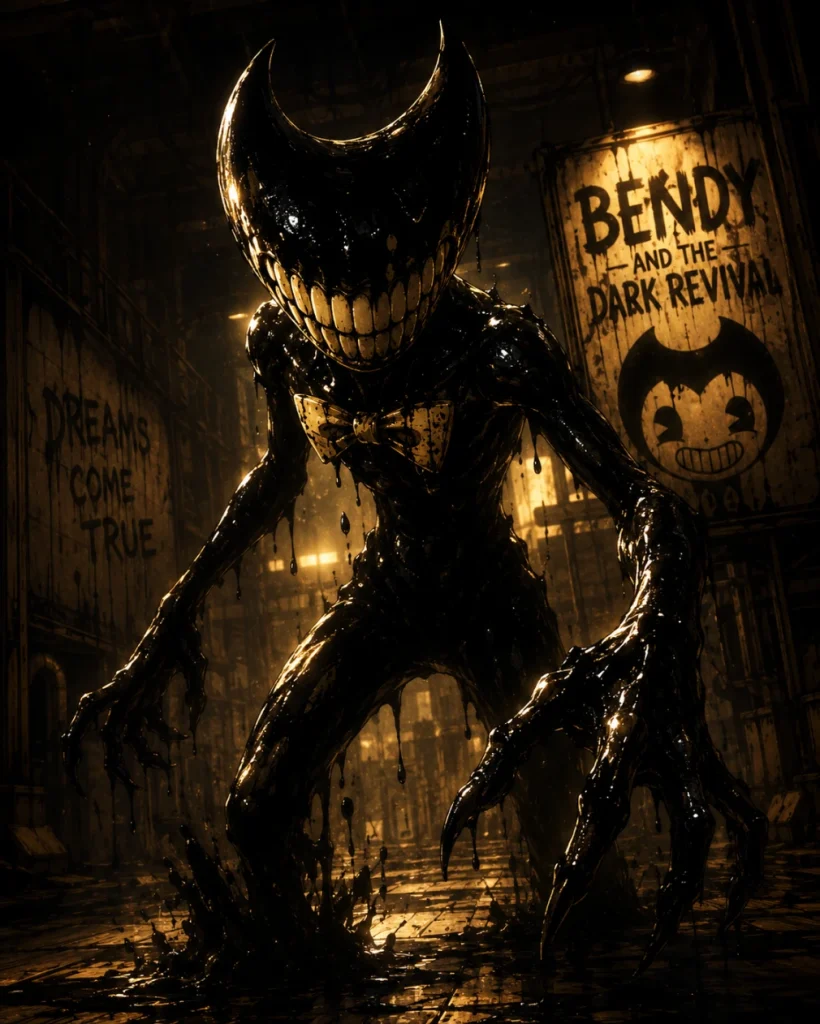
In this installment, the bendy and the dark revival ink demon transcends his initial role as a simplistic, silent slasher antagonist. He is fleshed out as a tragic, deeply malevolent deity born from the Ink Machine—a manifestation of raw creation stripped of a human soul.
The sequel explores his dual nature: his physical desire for complete dominance over “The Cycle” (the looping ink world) and his psychological torment of being a broken, unloved imitation of a cartoon icon.
Thematic Analysis: The Horror of the Canvas
The game positions itself as a cautionary tale detailing the destructive potential of human obsession.
1. The Hubris of the Creator
The overarching metaphor of the franchise is the toxic relationship between artists and their creations. Joey Drew’s desperate quest for immortality and artistic perfection mirrors the classic Faustian bargain. The bendy and the dark revival ink demon stands as the literal consequence of this creative hubris—an invention that grew too powerful, turned on its creators, and swallowed their humanity whole.
2. Ink as a Dual Motif
Throughout the game, ink acts as a brilliant narrative device symbolizing both life-giving genesis and corrosive destruction. It builds the stunning architecture of the studio and brings characters to life, yet it permanently stains, mutates, and traps souls in an endless loop of pain, illustrating how easily pure passion can curdle into madness.
Structural Matrix: Core Characters and Motifs
| Entity / Character | Lore Role | Thematic Symbolism | Primary Gameplay Dynamic |
| Audrey | Protagonist / Animator trapped in the Cycle. | Represents resilience, self-actualization, and untainted creativity. | Uses stealth, localized combat, and unique ink abilities to survive. |
| The Ink Demon | Sovereign ruler of the Ink World. | Symbolizes neglected creation, dark obsession, and cosmic body horror. | Omnipresent stalker; forces immediate tactical avoidance. |
| The Ink Substance | The biological and structural foundation of the world. | Represents the fluid, volatile line between art and monstrosity. | Serves as an environmental hazard, puzzle mechanic, and narrative anchor. |
Mechanical Upgrades: Surviving the Ink Demon
The transition to the sequel introduced a significant overhaul to the franchise’s core gameplay loop, shifting it from a walking simulator with minor combat into a tactical survival experience.
- Advanced Stealth and Strategy: Unlike the original game’s predictable chases, surviving the bendy and the dark revival ink demon requires active environmental awareness. Players must listen for structural cues, keep an eye out for flickering ink textures, and utilize lockers or shadows to bypass the demon’s keen senses.
- Somatic Upgrades and Puzzles: Audrey acquires supernatural ink-based abilities as she explores the studio. These powers are seamlessly integrated into environmental puzzles, meaning players must constantly interact with a world directly warped by the demon’s presence.
- Psychological Vulnerability: The game uses claustrophobic lighting, deep directional audio, and the looming threat of the demon’s sudden arrival to foster constant background anxiety, relying heavily on psychological tension over cheap jump scares.
Frequently Asked Questions (FAQ)
What is the true identity of the Bendy and the Dark Revival Ink Demon?
The Ink Demon is the very first entity ever created by the Ink Machine. Because he was brought to life without a human soul to anchor his personality, he emerged as a physically deformed, soulless monster. Joey Drew, horrified by his creation, locked him away in the depths of the studio, which ultimately caused the demon’s resentment and malice to fester.
What are the main powers of the Ink Demon in the sequel?
In this title, the demon exhibits near-godlike control over the cartoon realm. He can warp environmental spaces, corrupt local ink entities into grotesque subordinates, and project an overwhelming psychological aura that slows down and disorients the player. His presence is so absolute that players cannot fight him directly; they must drop everything and hide when he arrives.
What does the ending of the game imply for the future of the franchise?
The resolution of Audrey’s journey breaks open the boundaries between the real world and the ink dimension. By expanding the lore surrounding the Ink Machine’s properties, the ending sets up massive potential for future spin-offs, prequels, or sequels exploring the psychological weight of insanity, corporate ambition, and the global consequences of unleashing the ink.
Disclaimer: This article is intended strictly for educational, analytical, and gaming commentary purposes. “Bendy” and all associated characters are the intellectual property of Kindly Beast / Joey Drew Studios.