


Have you ever felt completely crushed by a sudden setback, spending days or weeks looking for someone—or something—to blame?
When a crisis hits, our default human setting is to seek a villain. We blame a toxic coworker, a stroke of terrible luck, or the universe itself. But according to ancient eastern philosophy, what we are actually experiencing isn’t a personal attack—it is an invitation to uncover a profound karmic lesson hiding beneath our pain.
Thousands of years before modern psychology, an overlooked story from the Mahabharata offered a radical cure for mental agony. It introduces a cosmic courtroom drama that teaches us how to decode every difficult karmic lesson we encounter in modern life.
The Story of Gautami, the Hunter, and the Serpent
In the Anushasana Parva of the Mahabharata, an elderly woman named Gautami is mentioned, who suffers the ultimate tragedy when she reaches home and sees her son lying dead. Her only son, whom she completely depends on, was bitten by a venomous snake and died.
A local hunter named Arjunaka heard the women crying and caught the serpent. Furious on Gautami’s behalf, he grabs the snake by its head, lifts it high into the air, and declares, “I am going to kill this beast to avenge your son.”
A deep philosophical breakdown
What happens next turns a standard revenge story into a deep philosophical breakdown of how a karmic lesson actually functions. Gautami tried to stop the hunter, stating that killing the snake wouldn’t bring her son back. At the very moment, the Serpent speaks: “Do not blame me, hunter. I have no hatred for this boy. I am merely a dependent instrument. I was ordered to bite him by Mrityu (the personification of Death).

Hearing the serpent blaming the forces of the universe, Mrityu (Death) manifests to utter the truth, to clarify the cosmic functionaries: Mrityu (Death) said: “Do not blame me either. I do not act out of malice. I am strictly directed by Kala (Time and Cosmic Destiny). We are just executing a universal law.”
After hearing this, Kala (Time and Cosmic Destiny) settles the debate: Kala reveals the ultimate truth. Neither the snake, nor Death, nor Time killed the boy. It was the result of the boy’s own past actions. That’s what karma he has done in the past; it comes to him as an action. This tragedy was the physical manifestation of the boy’s own destiny. The cosmic forces were simply the objective mechanism bringing that cause and effect to fruition, delivering a final karmic lesson.
Hearing this, Arjunaka’s grief dissolves into absolute clarity. He frees the snake and accepts the situation. He realizes there is no villain to fight—only an impartial universe balancing its scales.
The Anatomy of a Karmic Lesson: The Cosmic Executioner Mindset
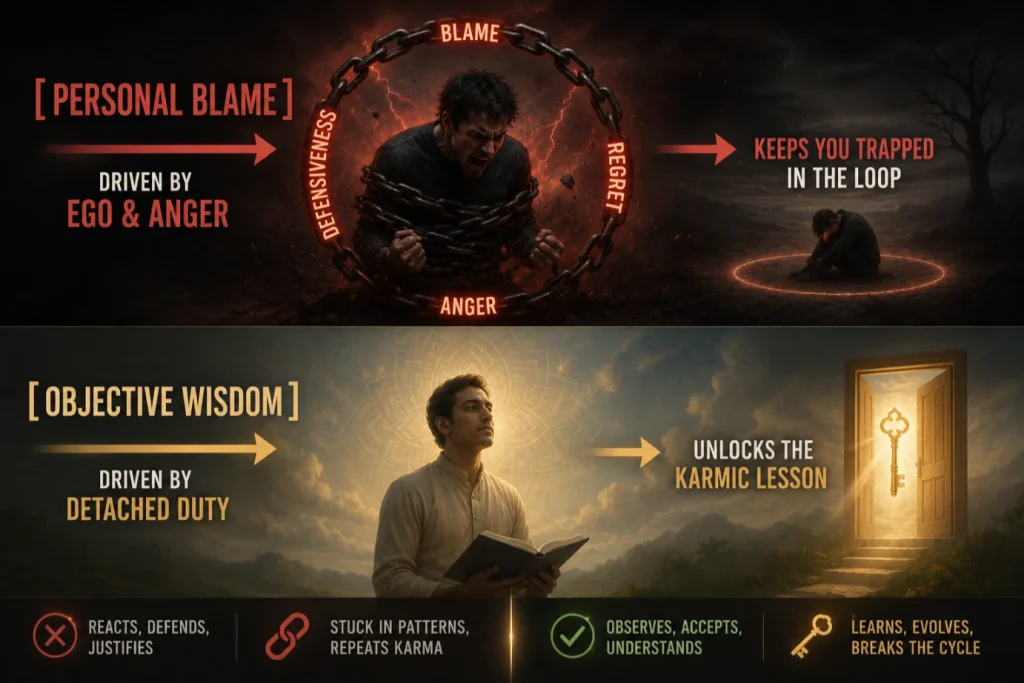
To truly extract the karmic lesson from a difficult life event, we have to understand the mindset of a modern courtroom executioner.
An executioner doesn’t pull the lever because they personally hate the condemned prisoner. They don’t celebrate the execution as a personal victory, nor do they feel personal guilt. They act without greed, anger, or selfish desire. They are simply an objective instrument carrying out a law.
[Personal Blame]    ---> Driven by Ego & Anger     ---> Keeps you trapped in the loop
[Objective Wisdom]  ---> Driven by Detached Duty   ---> Unlocks the karmic lesson
This is the exact shift Lord Krishna demands of Arjuna in the Bhagavad Gita. Arjuna collapses on the battlefield because his ego tells him that he is the sole doer of the action.
Krishna corrects him by explaining that the downfall of the opposing army has already been set in motion by their own choices. Arjuna is not a murderer acting out of hatred; he is merely the instrument of cosmic equilibrium. When you drop the egoistic sense of “I am the doer” (Karta Bhava), you stop fighting reality and finally see the karmic lesson presenting itself.
How to Decode Your Own Karmic Lesson in Modern Life
When you let go of the idea that the universe is personally out to get you, your relationship with stress changes entirely. Here is how to find the hidden karmic lesson when life gets heavy:
1. Shift from “Why Me?” to Objective Reality
When a project fails, a business closes, or a relationship ends, stop looking for a cosmic villain. Strip away the personal narrative. Realize that a massive web of variables converged to create this exact moment. It isn’t a personal punishment; it is a neutral event designed to teach you a specific karmic lesson about boundaries, reliance, or expectations.
2. Focus on Input, Detach from Output
Burnout happens when we tie our self-worth to results we cannot fully control. Do your job with absolute excellence and integrity, but surrender the need to dictate how the world reacts to it. True mastery means doing your duty cleanly, allowing the universe to deliver the results—and the subsequent karmic lesson—in its own time.
3. Respond Without Creating New Debt
When someone wrongs you, your instinct is to strike back in anger. But reacting with malice simply triggers a brand-new cycle of negative cause and effect. By treating the situation with objectivity—setting firm boundaries without harboring hatred—you successfully integrate the karmic lesson and ensure the cycle stops with you.
Final Thoughts: The Freedom of Integration
Gautami didn’t stop grieving because she didn’t care; she stopped because she realized that fighting a universal law is an exercise in futility.
When you look at your struggles through the lens of a karmic lesson, you stop wasting energy on bitterness, blame, and revenge. You stop asking “Who did this to me?” and start asking “What is this teaching me?” In that single shift, you are finally free to act with pure wisdom, objectivity, and total peace of mind.