

If you’ve watched The Boys, you know that Homelander doesn’t just think he’s a superhero—he genuinely believes he is a god.
In his eyes, baseline humans are nothing more than “mud” or ants. He believes his godlike power exempts him from human laws, human morality, and human judgment. His philosophy is terrifyingly simple: “I am stronger, faster, and smarter. Therefore, I can do whatever I want.”
This raises a fascinating, deeply provocative question that theologians and philosophers have argued over for centuries: Is Homelander’s terrifying worldview actually the same as how some religions view God?
When we look at the history of human mythology, the answer is a shocking yes—but with one massive, critical flaw.
The Volutand God: Punishment by Pure Will
To understand the connection, we have to look at a classic philosophical debate known as the Euthyphro Dilemma. It asks a simple question: Is something good because God commands it, or does God command it because it is inherently good?
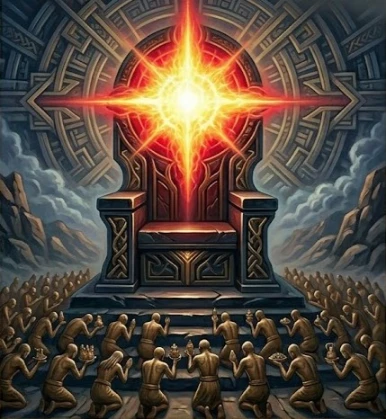
If you believe something is good simply because a supreme being commands it, you are leaning into a philosophy called Theological Voluntarism. In this framework, God’s power is so supreme that His Absolute Will comes before everything else.
This directly relates to how ancient polytheistic religions viewed their pantheons:
- The Capricious Greek Gods: Zeus, Poseidon, and Ares didn’t rule because they were morally perfect; they ruled because they had the lightning bolts. They threw tantrums, wiped out cities over petty slights, and changed the rules on a whim.
- The Mesopotamian Myths: In ancient Babylonian texts, the gods literally flooded the entire Earth simply because humans were making too much noise and keeping them awake.
In these ancient traditions, gods killed and punished purely at will. Like Homelander, their authority didn’t come from a place of perfect justice; it came from raw, unchecked, unchallengeable might.
The Rational God: Punishment by Recommended Law
However, as human philosophy evolved, major world religions shifted away from the idea of a moody, unpredictable deity. Instead, they introduced the concept of a supreme being governed by Immutable Cosmic Law.
If we take a look at how punishment works in Eastern philosophies. In these traditions, the universe runs on an impartial, mathematical system of cause and effect: Karma.
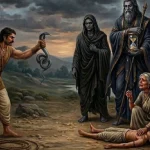
Think back to the famous Mahabharata story of the elderly woman Gautami, whose son was killed by a snake. When the forces of Time (Kala) and Death (Mrityu) manifest, they explain that they didn’t kill the boy out of anger or malice. They acted as cosmic executioners—impartial functionaries carrying out a sentence dictated entirely by the boy’s own past actions.
Even the highest gods in these traditions cannot punish someone purely “at will.” They are bound to uphold Dharma (cosmic order). The universe isn’t a dictatorship; it’s a flawlessly balanced energy.
The Crucial Difference: Ego vs. Duty
This is exactly where Homelander’s “god perspective” completely breaks down. He has the power of a Bronze Age deity, but he entirely lacks the wisdom of cosmic order.
| Feature | Homelander’s “God Complex” | The Cosmic Law Perspective |
| The Core Motivation | Pure Ego. Driven by insecurity, a desperate need for human applause, and fear of being unloved. | Impartial Duty. Operates without personal hatred, emotional attachment, or a desire to gloat. |
| Consistency | Capricious. The rules change depending on Homelander’s mood or what protects his brand. | Predictable. The laws of cause and effect apply universally to everyone, without exception. |
| The Ultimate Goal | Subjugation. Forcing the world to bow down to validate his existence. | Equilibrium. Restoring balance and justice to the universe. |
Homelander thinks he is a god because he can laser a crowd or abandon a plane full of civilians without consequence. But a true cosmic functionary acts like a courtroom executioner—they pull the lever not out of personal hatred for the condemned, but because a transcendent law demands it. Homelander doesn’t serve the law; he only serves himself.
Final Thoughts: The Terrifying Satire of The Boys
The brilliant tragedy of Homelander is that he is entirely artificial—brewed in a Vought lab out of Compound V. His “divinity” is corporate intellectual property, and his desperate need for human validation proves he is entirely codependent on the very species he claims to despise.
When we look at Homelander, we aren’t seeing a reflection of true divine justice. We are seeing a cautionary tale: a sharp, satirical warning of what happens when a being achieves the terrifying, unchecked power of a god, but remains trapped in the fragile, broken psychology of a human ego.