


Forgiveness is a vital pillar of emotional health. While society frequently emphasizes the importance of forgiving others, self-forgiveness is often the more grueling yet necessary hurdle for personal growth.
When we carry unresolved guilt or shame, it acts as a constant drain on our psychological well-being. This comprehensive guide breaks down the cognitive barriers to self-forgiveness and offers a clinical, step-by-step framework to help you release the past and reclaim your emotional freedom.
The Anatomy of Self-Forgiveness

Self-forgiveness is the intentional psychological process of releasing objective guilt, subjective shame, and self-directed resentment associated with a past action, omission, or decision.
Self-Forgiveness vs. Self-Justification
It is critical to distinguish healing from rationalization:
- Self-Justification: Minimizes or excuses harmful behavior, bypasses accountability, and stunts personal evolution.
- Self-Forgiveness: Fully acknowledges wrongdoing, accepts the emotional weight, processes the lesson, and actively chooses to decouple past actions from current self-worth.
The Cognitive Benefits of Letting Go
- Cortisol Reduction: Chronic guilt triggers a perpetual fight-or-flight state. Forgiveness regulates the nervous system, mitigating anxiety and depressive symptoms.
- Relational Intimacy: Unforgiven self-reproach often causes people to withdraw or accept toxic dynamics. Healing the self directly restores the capacity for deep, healthy connections.
- Behavioral Modification: Shifting the inner narrative from “I am a bad person” (shame) to “I did a bad thing, but I can change” (guilt) creates the psychological space required for genuine behavioral evolution.
Identifying the 4 Barriers to Self-Forgiveness
Before you can dismantle internal resentment, you must identify the cognitive distortions holding it in place:
- Maladaptive Perfectionism: Holding oneself to an impossibly rigid, flawless standard where any mistake is interpreted as a systemic failure of character.
- The “Expiation” Myth: The subconscious belief that punishing yourself with endless misery somehow balances the scales or prevents you from repeating the mistake.
- The Harsh Inner Critic: An overactive internal monologue that constantly repeats negative self-talk, distorting facts into generalized self-deprecation.
- Emotional Illiteracy: A fundamental misunderstanding of the healing process, viewing self-forgiveness as a sign of weakness rather than a prerequisite for progress.
The 8-Step Framework for Radical Self-Forgiveness
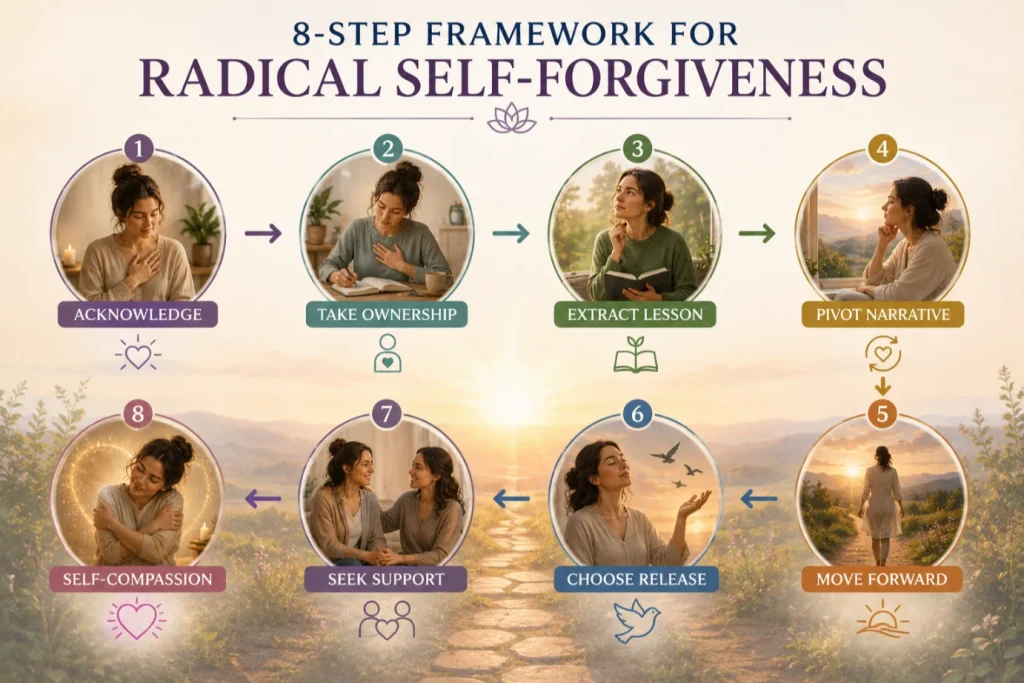
[Acknowledge] ➔ [Take Ownership] ➔ [Extract Lesson] ➔ [Pivot Narrative]
                                                               ⬇
[Move Forward] ⮠ [Choose Release] ⮠ [Seek Support] ⮠ [Self-Compassion]
Step 1: Radical Acknowledgment
You cannot heal what you refuse to look at. Acknowledge the exact feelings of guilt and shame without suppressing them.
- The Practice: Use Detox Journaling. Write a raw account of the event, exactly what occurred, how it made you feel, and why it continues to echo in your mind.
Step 2: Objective Accountability
Take clear responsibility for your actions. This is not about self-flagellation; it is about objective ownership. Avoid pointing fingers at external circumstances and cleanly state your role in the outcome.
Step 3: Cognitive Extraction (The Lesson)
Treat your misstep as a case study. Ask yourself: What blind spot or unmet need drove that behavior? What guardrails can I build to ensure this never happens again? This shifts your brain’s processing centers from emotional distress to constructive problem-solving.
Step 4: Challenge Cognitive Distortions
Interrogate your negative self-talk. Separate objective facts from emotional exaggerations.
- The Pivot: When the critic says, “You ruined everything; you’re a failure,” consciously reframe it to: “I made a severe error in judgment, but my past actions do not dictate my future capabilities.”
Step 5: Implement Active Self-Compassion
Treat yourself with the exact level of grace, vocabulary, and empathy you would offer a close friend or a child who made the identical mistake. Remind yourself that fallibility is a universal human trait.
Step 6: Secure External Feedback
Guilt thrives in isolation. Share your burden with a trusted ally, mentor, or licensed professional counselor. An objective, empathetic outside perspective can instantly break up a localized mental echo chamber.
Step 7: The Conscious Act of Release
Self-forgiveness is ultimately an active, daily decision, not a passive destination. You must verbally and mentally declare the debt settled.
- The Affirmation: Speak aloud: “I have accounted for my mistakes, extracted the wisdom, and I now cleanly release this guilt to live fully in the present.”
Step 8: Values-Aligned Forward Motion
Anchor your healing in real-world actions. Set clear goals, lean into communities that nurture your growth, and construct a life built on your corrected values. Forgiveness doesn’t rewrite your history, but it entirely changes your trajectory.
Diagnostic Matrix: Is Your Guilt Healthy or Toxic?
| Metric | Healthy Guilt (Adaptive) | Toxic Shame (Maladaptive) |
| Focus Area | Focuses entirely on the behavior (“I made a poor choice”). | Focuses entirely on the identity (“I am a fundamentally flawed person”). |
| Outcome | Drives corrective action, apologies, and behavioral changes. | Leads to paralysis, social isolation, and self-sabotage. |
| Duration | Dissipates once accountability is taken and lessons are learned. | Lingers indefinitely, becoming a core pillar of your self-image. |
Advanced Interventions When Progress Stalls
If the cognitive steps above feel impossible to implement, your psyche may be dealing with deep-rooted trauma or emotional blockages. Consider these expert-backed paths:
- Targeted Psychotherapy: Engaging with a professional practicing Cognitive Behavioral Therapy (CBT) or Eye Movement Desensitization and Reprocessing (EMDR) can help unpack complex, deeply wired shame.
- Somatosensory Mindfulness: Practice grounding techniques to drop out of looping mental narratives and physically process the heavy energy stored in the body.
- Altruistic Channeling: Volunteer or support a cause related to your past mistake. Transforming your internal regret into external, positive social impact is one of the fastest paths to restoring self-worth.
Frequently Asked Questions (FAQ)
Does forgiving myself mean I am condoning or excusing what I did?
Absolutely not. Condoning removes responsibility. Self-forgiveness requires total accountability. It means accepting that while the event cannot be changed, punishing yourself indefinitely does absolutely nothing to fix the past or improve the future.
How do I know when I have truly forgiven myself?
The most reliable indicator is emotional neutrality. When you remember the event, it will no longer trigger a sharp, visceral spike of panic, sickness, or shame in your stomach. Instead, it will feel like a historical fact—a painful chapter, but one that is firmly closed.
What if I cannot make amends to the person I hurt?
If direct amends are impossible or would cause the other person more harm, you must make amended actions elsewhere. Direct that restorative energy toward the world at large by mentoring others, volunteering, or changing your behavior in current relationships.
Disclaimer: The psychological strategies outlined in this guide are for educational purposes. If you are experiencing persistent depression, severe anxiety, or intrusive thoughts, please reach out to a licensed mental health professional immediately.
Recommended Resources for Continued Healing
- Literature: “The Gifts of Imperfection” by Dr. Brené Brown (An essential text on breaking down the mechanics of shame and perfectionism).
- Clinical Support: Utilize national mental health databases to locate credentialed specialists specializing in CBT and trauma-informed recovery.