

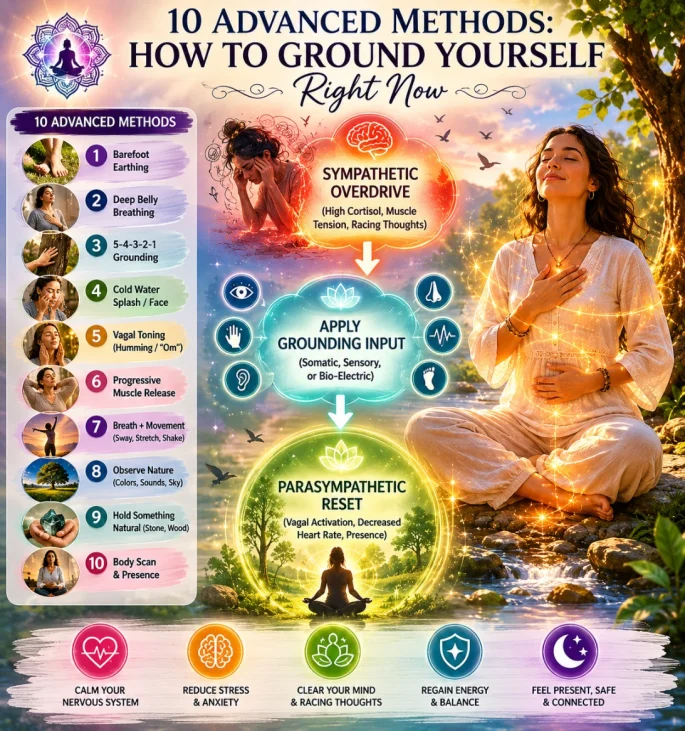
In an era of relentless digital stimuli and chronic stress, it is incredibly easy for our nervous systems to become hyper-aroused. When this occurs, we frequently experience structural symptoms of disconnect: racing thoughts, physical restlessness, or a floating sense of dissociation.
Learning how to ground yourself—the practice of deliberately reanchoring your awareness to the immediate physical environment and your biological body—is a clinically backed antidote to somatic overwhelm.
This comprehensive guide breaks down the biological mechanisms behind energetic stabilization and provides ten structured, step-by-step techniques to down-regulate your nervous system in real-time.
The Science Behind How to Ground Yourself
From a neuropsychological perspective, understanding how to ground yourself is not merely a mindfulness exercise; it is an active intervention in your autonomic nervous system (ANS).
When you experience acute stress or anxiety, your body defaults to the sympathetic nervous system (the fight-or-flight response). Your heart rate increases, cortisol spikes, and your brain’s threat-detection center—the amygdala—takes over.
Grounding techniques intentionally shift neural activation back to the parasympathetic nervous system (the rest-and-digest response) via the vagus nerve. By forcing your brain to process immediate, safe sensory inputs, you send a structural signal to your brain stem that the threat has passed.
Proven Physiological Benefits
- Cortisol Modulation: Rapidly lowers circulating stress hormones, breaking the cycle of chronic tension.
- Vagal Tone Enhancement: Strengthens your heart rate variability (HRV), making you inherently more resilient to sudden stressors.
- Immediate Cognitive Reset: Shifts your brainwave state away from erratic high-beta loops into focused, calm alpha frequencies.
- Inflammation Reduction (Earthing): Physical grounding to the earth introduces free electrons to the skin, which act as natural antioxidants to neutralize systemic physical inflammation.
10 Advanced Methods: How to Ground Yourself Right Now
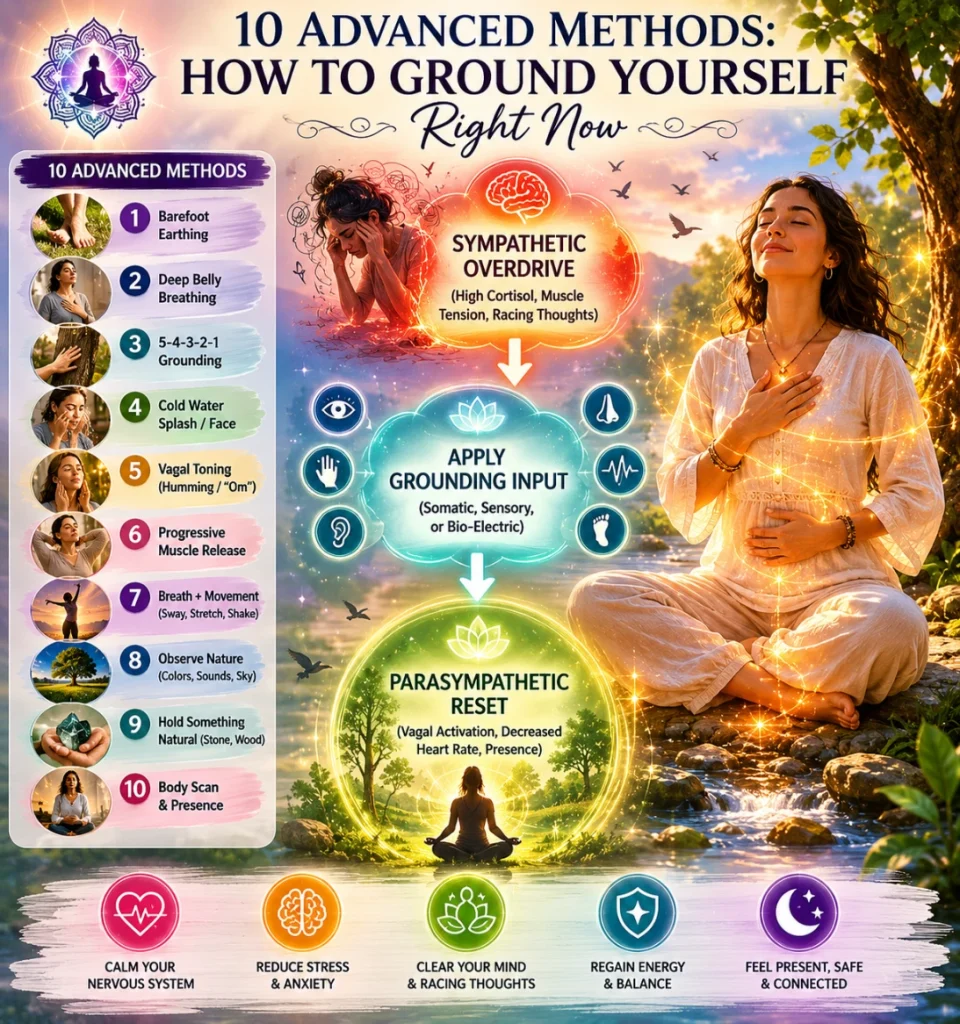
  [Sympathetic Overdrive] ➔ (High Cortisol, Muscle Tension, Racing Thoughts)
           ⬇
  [Apply Grounding Input] ➔ (Somatic, Sensory, or Bio-Electric)
           ⬇
  [Parasympathetic Reset] ➔ (Vagal Activation, Decreased Heart Rate, Presence)
1. The 5-4-3-2-1 Sensory De-escalation Protocol
This cognitive-behavioral therapy (CBT) staple works by hijacking your sensory processing centers, forcing your brain out of internal panic loops and into external reality.
- The Workflow: Look around your immediate space and deliberately state aloud:
- 5 things you can see (e.g., a specific shadow, a pen, a water droplet).
- 4 things you can physically feel (e.g., the texture of your jeans, the cold desk surface).
- 3 things you can hear (e.g., distant traffic, an air conditioner hum).
- 2 things you can smell (e.g., coffee grounds, clean laundry).
- 1 thing you can taste (e.g., the lingering trace of mint or toothpaste).
2. Autonomic Resonant Breathing (Coherent Breathing)
Manipulating the duration of your exhalations directly tells your brain that it is safe to slow down your heart rate.
- The Workflow: Sit erect with both feet flat on the floor. Inhale cleanly through your nose for a strict count of 4. Hold the breath at the top for 4 counts. Exhale slowly through pursed lips for a count of 6. Extending the exhale longer than the inhale is the specific biological trigger required to activate the vagus nerve.
3. Bio-Electric Earthing (Direct Earth Contact)
- The Workflow: Step entirely barefoot onto a patch of natural grass, damp soil, sand, or unsealed concrete for a minimum of 15 to 20 minutes.
- The Science: The Earth carries a subtle, natural negative electrical charge. When your bare skin makes direct contact with the ground, your body absorbs mobile electrons, which stabilize your internal bio-electrical environment and help regulate circadian rhythms.
4. Somatosensory Rooting Visualization
- The Workflow: Close your eyes and breathe evenly. Visualize thick, heavy, luminous roots extending from the soles of your feet deep through the floorboards and anchoring hundreds of feet down into bedrock. On every exhalation, imagine pouring your excess mental static, anxiety, and frantic energy down these roots to be neutralized by the earth.
5. Proprioceptive Thermal Anchoring
- The Workflow: Hold an ice cube in the palm of your hand for 30 seconds, or splash ice-cold water directly onto your face. The intense, sudden temperature shift stimulates the trigeminal nerve and activates the mammalian dive reflex, which instantly lowers an elevated heart rate and snaps you back into physical reality.
6. Mindful Proprioception Meditation

- The Workflow: Sit comfortably and close your eyes. Instead of tracking your breath, focus 100% of your attention on the precise points of physical contact between your body and the environment. Feel the exact pressure of your thighs on the chair, the gravity pulling your sit bones down, and the solid support of the floor against your heels.
7. Vestibular and Somatic Movement (Yoga)
- The Workflow: Drop into static, grounding yoga postures such as Tadasana (Mountain Pose) or Balasana (Child’s Pose). Focus entirely on pushing your weight deliberately into the floor. Alternatively, use rhythmic “shaking therapy”—vigorously shaking your arms, legs, and torso for 60 seconds to physically discharge trapped adrenaline from your muscle tissue.
8. Olfactory Limbic System Stimulation
- The Workflow: Keep a bottle of high-purity, grounding essential oils at your desk. When anxiety spikes, inhale deeply from oils with heavy molecular profiles: Vetiver (deeply grounding), Cedarwood (stabilizing), or Patchouli (earthy anchoring).
- The Science: Olfactory signals travel directly to the amygdala and limbic system without being processed by the analytical neocortex first, making scent one of the fastest ways to alter your emotional state.
9. Descriptive Environmental Journaling
- The Workflow: When your mind begins to spin, open a notebook. Instead of writing about your internal feelings, write a highly detailed, purely objective description of your physical surroundings.
- Example: “I am sitting on a grey fabric chair. To my left is a wooden table with three scratches on the corner. The light coming through the window is cast at a 45-degree angle.” This anchors your cognitive focus directly to external reality.
10. Core Haptic Touch Reinforcement
- The Workflow: Place your right hand firmly over your heart and your left hand flat on your abdomen. Apply gentle, warm pressure. Close your eyes and focus exclusively on the physical rises and falls of your chest and belly. This targeted pressure mimics deep-touch pressure therapy, inducing an immediate sense of biological safety.
Symptom-to-Technique Mapping Matrix
To maximize efficiency, select your strategy based on your specific type of nervous system dysregulation:
| If Your Symptom Is… | Nervous System State | Primary Recommended Technique |
| Racing thoughts, panic attacks, heart palpitations | Hyper-Arousal (Sympathetic Drive) | Thermal Anchoring / 5-4-3-2-1 Technique |
| Dissociation, numbness, feeling “spaced out” | Hypo-Arousal (Dorsal Vagal Shutdown) | Proprioceptive Movement (Shaking) / Cold Water Splash |
| Chronic low-grade stress, muscle tightness | Allostatic Load (Chronic Stress) | Bio-Electric Earthing / Coherent Breathing |
| Mental fatigue, inability to focus on tasks | Cognitive Overload | Olfactory Stimulation / Descriptional Journaling |
How to Build a Daily Routine Around Grounding
Learning how to ground yourself is most effective when used as a preventative daily habit rather than just an emergency tool for panic attacks.
- The Morning Anchor (3 Mins): Before checking your smartphone, stand up and perform 2 minutes of Coherent Breathing while keeping your bare feet firmly planted on the floor.
- The Midday Reset (5 Mins): Step away from your computer screen every afternoon to perform the 5-4-3-2-1 technique or apply a grounding essential oil like Vetiver.
- The Evening Decompression (15 Mins): Walk barefoot in nature or take a warm shower while intentionally visualizing the mental static of the day washing down the drain.
Frequently Asked Questions (FAQ)
What is the absolute fastest way to ground yourself during a panic attack?
The fastest way to snap out of acute hyper-arousal is a physical temperature shock. Splashing freezing cold water on your face or holding an ice cube stimulates the vagus nerve instantly, overriding looping mental thoughts and forcing your awareness back into the physical present.
What is the difference between mindfulness and grounding?
While highly complementary, they have distinct functions. Mindfulness is the broad practice of observing your thoughts and feelings without judgment. Grounding is a narrower, somatic intervention explicitly designed to pull your awareness out of your mind and anchor it deeply into your physical body and immediate environment.
Can I practice these techniques if I live in a city without easy access to nature?
Yes, absolutely. Knowing how to ground yourself is an entirely portable skill. You can achieve excellent somatic anchoring indoors by using haptic touch, thermal shifts (ice/cold water), conscious breathwork, or the 5-4-3-2-1 technique. Your physical body is always available as an anchoring mechanism, regardless of your geographic location.
Disclaimer: The neurological and somatic grounding strategies outlined in this guide are intended for educational and stress-management purposes. If you are experiencing severe panic disorders, clinical depression, or persistent dissociation, please consult with a licensed mental health professional.