

When you read ancient Puranic stories, one specific tale leaves modern readers completely shocked.
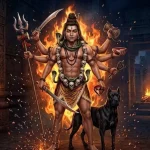
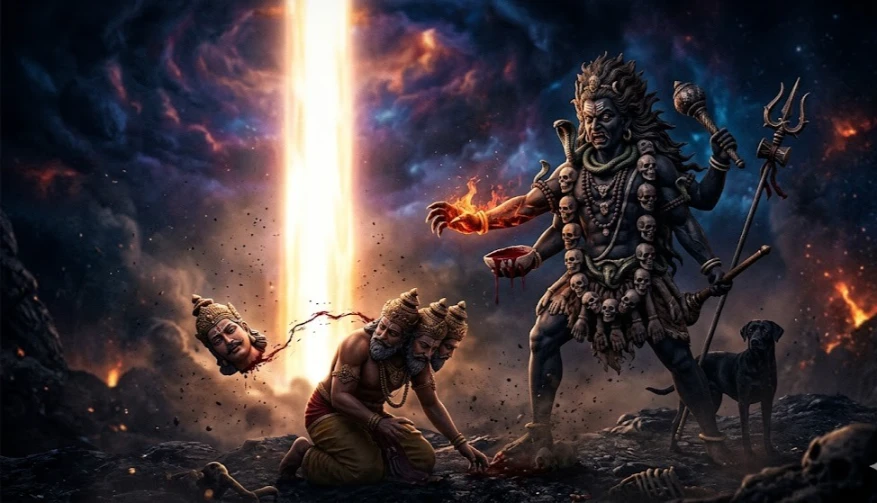
The story goes that Lord Brahma (the Creator) grew incredibly arrogant. To punish him, Lord Shiva manifested his most terrifying, wrathful avatar—Kaal Bhairava—and violently chopped off Brahma’s fifth head with a single flick of his fingernail.
At first glance, this looks like a cosmic soap opera. It raises a massive, uncomfortable question that most mainstream spiritual gurus completely avoid:
If Shiva cannot tolerate Brahma’s pride and reacts by brutally decapitating him, doesn’t that mean Shiva himself is full of a petty, bruised ego?
To understand why this isn’t a divine temper tantrum, we have to look past the blood and iconography and dive into the deep, non-dual physics of Tantra.
1. The Cop vs. The Criminal: Cosmic Law Over Personal Pride
To understand Shiva’s actions, we have to look at the difference between a personal vendetta and cosmic justice.
Think of a judge sentencing a criminal to life in prison. The judge isn’t doing this because their personal feelings are hurt or because they want to feel powerful. They are enforcing the law to keep society from collapsing into chaos.
When Bhairava cut off Brahma’s head, he wasn’t acting as a “person” defending his hurt feelings. He was acting as Cosmic Order (Rta).
According to the text, Brahma had just lied about finding the top of Shiva’s infinite pillar of light. When the deity responsible for building the universe becomes arrogant and deceitful, the very fabric of reality begins to rot. Shiva’s intervention was a critical structural correction, not an ego trip.
2. The Absolute Mirror: Slicing Your Own Shadow
In the highest levels of Hindu philosophy (Advaita Shaivism), the ego requires two things: a “Me” and a “You.” For me to have an ego, I must see you as separate from me and want to prove I am superior.
But Shiva is not a person. Shiva is Brahman—the infinite, omnipresent consciousness that forms the background screen of the entire universe. Everything and everyone, including Brahma, exists inside of Shiva.
Therefore, when Bhairava cuts off Brahma’s head, Shiva is essentially cutting off a piece of Himself.
It is exactly like waking yourself up from a terrifying nightmare by violently shaking your own body. Shiva isn’t fighting an external enemy; he is forcefully awakening a part of his own cosmic consciousness that got trapped in the illusion of ego.
3. The Scalpel of Wrath: Compassion in Disguise
In modern society, we are taught that anger is always a toxic, negative emotion. But Tantra introduces a radically different concept: Ugra—a sacred, fierce energy born out of absolute compassion.
Imagine a surgeon discovering a rapidly growing, deadly tumor inside a patient. The surgeon doesn’t speak politely to the tumor or try to reason with it. They take a cold, sharp scalpel and violently cut it out of the body.
To an outside observer who doesn’t understand medicine, slicing someone open looks like an act of violence. But to the surgeon, it is the only way to save the patient’s life.
Brahma’s fifth head was a spiritual tumor of unchecked pride. Bhairava was the cosmic scalpel. It was an act of fierce grace to save Brahma from his own spiritual downfall. Notice what happens next in the myth: the moment the head falls, Brahma’s illusion shatters, he humbly bows to Shiva, and he is instantly restored to his holy duties.
The Ultimate Lesson for Us
The Puranas don’t tell these violent stories to entertain us; they tell them to hold a mirror up to our own minds.
Brahma’s four healthy heads represent structured, useful knowledge (the four Vedas). But that top, fifth head represents Ahankara (the Ego)—the part of our intellect that becomes arrogant, lies to protect its status, and hoards attachments.
The myth teaches us that the ego is incredibly stubborn. You cannot reason with your deepest insecurities, addictions, or toxic pride. It requires a sudden, uncompromising, and fierce shift in awareness—a true “Bhairava moment”—to slice through our own illusions and see reality as it truly is.
What do you think?
Was Shiva’s act one of cosmic ego or ultimate liberation? Drop your thoughts in the comments below!
If you found this breakdown fascinating, don’t forget to share it with someone who loves exploring the deeper side of mythology!