
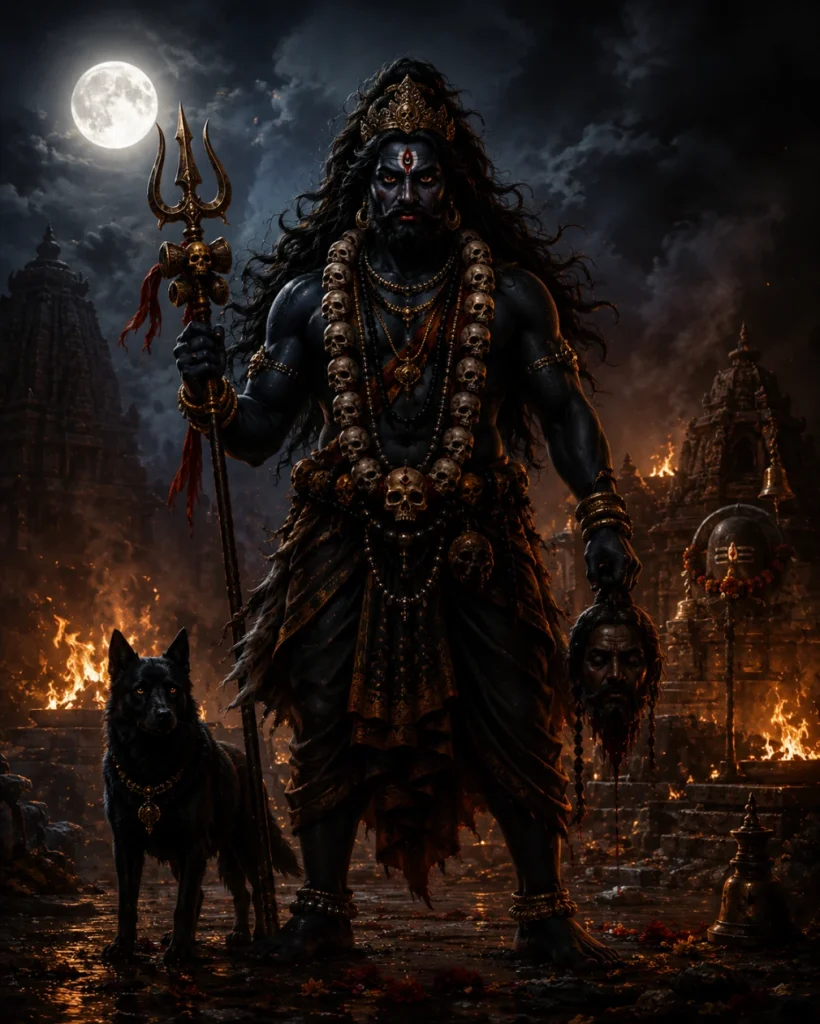

Bhairava is the ultimate manifestation of fearlessness (Abhaya) and cosmic protection. He is the fearsome form of Shiva stripped of all social pleasantries—the raw, unfiltered reality of time, death, and spiritual liberation.
Through dedicated worship and contemplation, followers of Bhairava Baba can harness his attributes and cultivate an inner sanctuary of resilience and wisdom. If you want to understand the esoteric depth of this deity, his powerful mantras, and how to approach his energy without fear, this deep dive will uncover what the mainstream textbooks leave out.
1. Origins & Appearance
The name Bhairava originates from the Sanskrit roots Bhi (fear), Ra (sound/resonance), and Va (manifestation). He is mentioned as”The Roar That Commands Fear.” Yet, esoterically, the three syllables represent Bharma (creation), Ramana (sustenance), and Vamana (liberation), making him the ultimate master of the universe’s lifecycle.
Origins Story
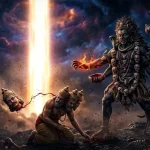
There is a most famous Puranic legend that mentions how Bhairava came into existence. According to the Shiva Purana, once Brahma (the Creator deity) grew arrogant and developed five heads. He began to look down upon Shiva with ego and disrespect.
To shatter Brahma’s ego, punishing dishonesty, and destroying cosmic arrogance, Shiva manifested his most terrifying form: Bhairava. With a single flick of his fingernail, Bhairava sliced off Brahma’s fifth head.
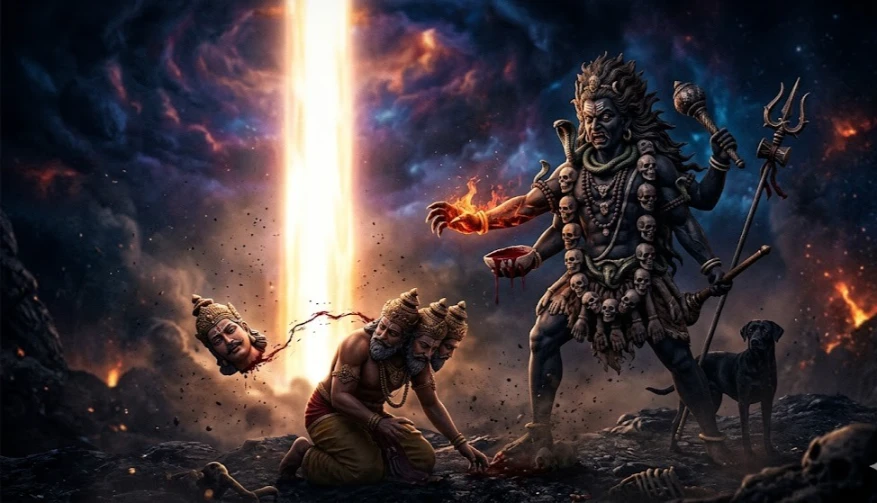
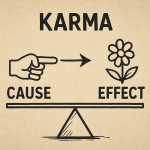
The Karmic Price: Because he committed Brahmahatya (the sin of killing a Brahmin), Brahma’s severed skull (Kapala) stuck to Bhairava’s left hand like a curse. No matter how hard he tried to shake it off, it wouldn’t budge. Along with the skull, a terrifying, wrathful feminine deity representing the sin itself—Brahmahatya Papa Personified—began to chase Bhairava through the universe, tormenting him. To burn away this intense karma, Bhairava had to take the vow of a Kapalika (a skull-bearing ascetic). He spent ages wandering through different worlds, dimensions, and sacred spaces, begging for food using Brahma’s skull as his begging bowl.
He visited countless holy rivers and powerful ashrams, but no place in the cosmos possessed an energetic frequency high enough to wash away the stain of his sin. Finally, Bhairava’s wanderings brought him to the banks of the River Ganges in the ancient city of Varanasi (also known as Kashi).
Liberation
Varanasi is not considered a normal piece of earthly land in Hindu metaphysics. It is called Avimukta Kshetra (the city never forsaken by Shiva) and is believed to rest directly on the tip of Shiva’s spiritual trident, existing outside the normal laws of worldly space and karma.
The moment Bhairava stepped foot into the boundary of Varanasi, the overwhelming spiritual purity and liberating energy of the land instantly neutralized the curse. The personified sin of Brahmahatya could not enter the city and dissolved at the border. Instantly, the severed skull slipped off Bhairava’s hand and fell to the ground, liberating him.
2. Decoding the Esoteric Symbolism
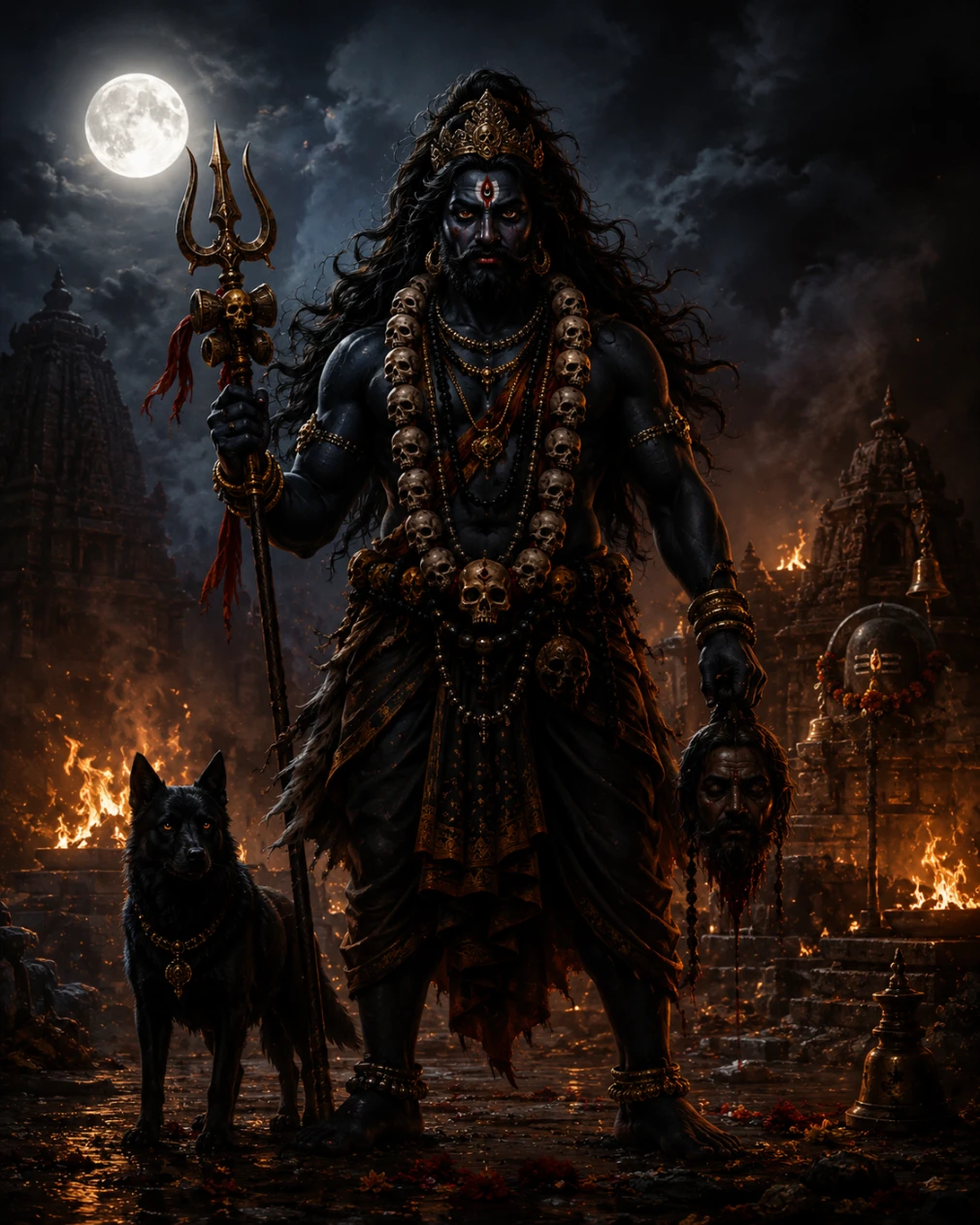
Every terrifying feature of Bhairava is a profound metaphysical metaphor designed to shock the human mind out of material illusion (Maya):
- The Naked Ascetic (Digambara): He wears nothing but space. This symbolizes absolute truth, completely stripped of societal expectations, ego, and artificial identity.
- The Crescent Moon & Snakes: Like Shiva, he wears snakes around his neck and a crescent moon in his matted hair, proving that he controls both the toxic poisons of life and the rhythmic cycles of time.
- The Dog Companion (Shvana): Bhairava’s vehicle (Vahana) is a black dog. In ancient Vedic culture, dogs were seen as unclean outcasts associated with cremation grounds. By making the dog his sacred companion, Bhairava shatters our concepts of “pure” vs. “impure,” teaching us that the divine exists in the lowest elements of reality.
- The Trident (Trishula) & Drum (Damaru): The trident cuts through the three layers of human misery (physical, mental, and spiritual), while the drum beats out the primal sound of the cosmos.
3. The Ashta Bhairava: The Eight Lords of Direction
On a literal level, Bhairava multiplies himself to govern different aspects of reality. He doesn’t exist as a single form sitting in one heaven. In Tantra, he manifests as the Ashta Bhairava (Eight Bhairavas), guarding the eight cardinal directions of the universe. Each form governs a different aspect of human consciousness and is paired with a specific Matrika (Mother Goddess):
| Bhairava Form | Direction | Core Power / Energy Governed |
| Asitanga Bhairava | East | Enhances creative abilities and clears creative blocks. |
| Ruru Bhairava | Southeast | The divine educator; conquers ignorance and enemies. |
| Chanda Bhairava | South | Cuts through cutthroat competition and grants immense self-confidence. |
| Krodha Bhairava | Southwest | Gives the power to take massive, high-stakes life decisions. |
| Unmatta Bhairava | West | Quiets an overactive mind and controls damaging ego/arrogance. |
| Kapala Bhairava | Northwest | Ends fruitless work and eliminates unproductive mental labor. |
| Bhishma Bhairava | North | Clears deep-seated spirits of fear, anxiety, and doubt. |
| Samhara Bhairava | Northeast | Complete dissolution of past negative karma and spiritual rebirth. |
Overseeing them all is Kaal Bhairava, the Lord of Time itself, who determines when our worldly illusions must come to an absolute end.
The 64 Bhairavas Name, Mantra & Rituals
In advanced Tantric texts like the Rudrayamala Tantra and the Shiva Agamas, the 64 Bhairavas represent the geometric expansion of the universe’s rawest, most protective forces.
Each chief Bhairava presides over 7 subordinate manifestations, resulting in a perfect grid of 64 cosmic guardians. Bhairava is a massive, geometrically perfect network of 64 distinct cosmic forces. They form a universal protective grid, split into eight distinct clans (Kulas), with each clan governing a different dimension of reality, human psychology, and the human chakra system.
Given Below is the advanced, esoteric breakdown of these 64 forces, their traditional visual descriptions, and the secret mantras used by high-level practitioners to invoke them.
1. The Asitanga Clan (The Golden Light)
- The 8 Secret Names: Asitanga (Chief), Vishalaksha, Marttanda, Modaka-priya, Svacchanda, Vighna-santushta, Khecara, and Sacharachara.
- The Visual Form: Dazzling golden complexions, physically well-built, carrying a trident (Trishula), a drum (Damaru), and a sacrificial dagger (Khadga).
- Chakra & Power: Governs the Muladhara (Root) Chakra. Invoked to completely erase paralyzing mental blocks, fear of poverty, and creative dry spells.
- The Clan Mantra: Om Hreem Asitangaya Namah
2. The Ruru Clan (The Pure White Ascetics)
- The 8 Secret Names: Ruru (Chief), Kroda-damshtra, Jatadhara, Vishvarupa, Virupaksha, Nanarupadhara, Vajrahasta, and Mahakaya.
- The Visual Form: Pure white like snow, heavily adorned with rubies, holding a Rudraksha mala, an elephant-driver’s goad (Ankusha), a musical Vina, and a palm-leaf manuscript.
- Chakra & Power: Governs the Svadhishthana (Sacral) Chakra. Invoked for the absolute destruction of ignorance, heavy legal battles, and cutthroat professional competitors.
- The Clan Mantra: Om Hreem Ruru Bhairavaya Namah
3. The Chanda Clan (The Blue Thunder)
- The 8 Secret Names: Chanda (Chief), Pralayantaka, Bhumikampa, Nilakantha, Vishnu, Kulapalaka, Mundapala, and Kamapala.
- The Visual Form: Strikingly handsome with deep, sapphire-blue complexions. They carry cosmic fire (Agni), a heavy mace (Gada), a skull cup, and a weapon of pure kinetic force (Shakti).
- Chakra & Power: Governs the Manipura (Solar Plexus) Chakra. They grant unshakeable, hypnotic self-confidence and shield your aura against psychic attacks or low-vibrational jealousy.
- The Clan Mantra: Om Hreem Chandaya Namah
4. The Krodha Clan (The Smoky Executioners)
- The 8 Secret Names: Krodha (Chief), Pingalekshana, Abhrarupa, Dharapala, Kutila, Mantranayaka, Rudra, and Pitamaha.
- The Visual Form: Smoky-grey or ash-colored, wearing menacing, fierce expressions. They carry a dagger, a heavy protective shield, a long broadsword, and a battle-axe.
- Chakra & Power: Governs the Anahata (Heart) Chakra. Worshipped to aggressively cut through toxic karmic cords, lingering childhood traumas, and to give you the spine needed to make high-stakes life changes.
- The Clan Mantra: Om Hreem Krodha Bhairavaya Namah
5. The Unmatta Clan (The Serene Masters)
- The 8 Secret Names: Unmatta (Chief), Vatukanayaka, Shankara, Bhutavetala, Trinetra, Tripurantaka, Varada, and Parvatavasa.
- The Visual Form: Blindingly white with an otherworldly, pristine beauty. They carry a short spear, a shield, a mace, and a skull cup.
- Chakra & Power: Governs the Vishuddha (Throat) Chakra. They quiet an overactive, anxious mind, instantly crushing the toxic pride and vanity that sabotages human relationships.
- The Clan Mantra: Om Hreem Unmattaya Namah
6. The Kapala Clan (The Yellow Sovereigns)
- The 8 Secret Names: Kapala (Chief), Shashibhushana, Hasticarmambaradhara, Yogisha, Brahmarakshasa, Sarvajna, Sarva-devesha, and Sarva-bhutahridi-sthita.
- The Visual Form: Gleaming with a brilliant yellow-gold complexion. They wield a thunderbolt (Vajra), an inescapable noose (Pasha), a short sword, and a skull-bowl.
- Chakra & Power: Governs the Ajna (Third Eye) Chakra. They put a sudden, violent end to stagnant work, mountain-high financial debts, and unproductive mental labor.
- The Clan Mantra: Om Hreem Kapala Bhairavaya Namah
7. The Bhishana Clan (The Crimson Wardens)
- The 8 Secret Names: Bhishana (Chief), Bhayahara, Sarvajna, Kalagni-Maharaudra, Dakshina, Mukhara, and Asthira.
- The Visual Form: Deep, blood-red complexions. They carry a long-handled executioner’s sword, a skull cup, a sharp trident, and a heavy wooden pestle.
- Chakra & Power: Governs the Bhale (Forehead) Chakra. They destroy deep-seated phobias, ancestral curses, and entities attached to your psychological shadow.
- The Clan Mantra: Om Hreem Bhishanaya Namah
8. The Samhara Clan (The Cosmic Lightning)
- The 8 Secret Names: Samhara (Chief), Atiriktanga, Kalagni, Priyankara, Hriananda, Vishalaksha, and Dakshasamsthita.
- The Visual Form: Dazzling orange and gold, glowing violently like a massive crack of lightning across a stormy sky. They are multi-armed, carrying a discus, a mace, a conch, and a skull-topped staff.
- Chakra & Power: Governs the Brahmarandhra (Crown) Chakra. This is the ultimate spiritual “reset button”—invoked to dissolve a lifetime of heavy, stagnant karma and trigger an instant spiritual rebirth.
- The Clan Mantra: Om Hreem Samhara Bhairavaya Namah
3 Hidden Secrets Left Out of Mainstream Texts
Advanced Tantra protects specific hidden dimensions of this 64-matrix that regular textbooks purposely omit to prevent misuse:
Secret #1: The Mirror-Link to the 64 Yoginis
The 64 Bhairavas do not operate alone. In esoteric anatomy, they exist in absolute lockstep with the 64 Yoginis (the dynamic feminine forces of the cosmos). While the Yogini represents the raw, chaotic, kinetic energy (Shakti) that drives creation and destruction, her corresponding Bhairava represents the absolute, unshakeable space (Shiva) that focuses and directs that energy. You cannot truly awaken one without the other.
Secret #2: The Body Grid (Mahashoddha-nyasa)
In high-level Shri Vidya and Natha traditions, the 64 Bhairavas are not viewed as outer entities living in a distant heaven—they are mapped directly onto your subtle body. When an advanced practitioner chants their names, they are energetically lighting up 64 micro-junctions along their central meridian channel (Sushumna Nadi). This acts as a cosmic cage, trapping your escaping lifeforce energy (Prana) and driving it straight up the spine.
Secret #3: The Safest Way for Householders to Practice
Because the energy of the 64 Bhairavas is fast, intense, and borderline chaotic, traditional Left-Hand Tantra (Vamachara) restricts their rituals to the midnight hour in absolute isolation.
However, regular householders can safely tap into the collective power of all 64 forms without complex rituals. The secret is chanting the comprehensive Chatushashti Bhairav Namavali Stotram during a waning moon, or simply listening to authentic recordings of the names.
To hear how these traditional, powerful names sound when woven into a continuous Sanskrit chant for protection, you can listen to this recording of the Chatushashti Bhairav Names from the Rudrayamala Tantra, which covers the exact, unbroken sequence of the 64 forms.
4. The Science of Bhairava Sadhanas & Mantras
Worshipping Bhairava requires mental discipline. Because his energy is incredibly intense and fast-acting, practitioners usually approach him during Rahu Kaal (the most astrologically volatile time of the day) or on Ashtami (the eighth day of the lunar cycle).
The Sacred 108 Repetitions
In accordance with traditional Tantric and Vedic geometry, a Bhairava mantra should be chanted exactly 108 times using a Rudraksha mala. The number 108 represents the cosmic alignment of the self with the universe (the 12 zodiac houses multiplied by the 9 planets). Chanting a deity mantra 108 times builds a protective energetic shield (Kavacham) around the practitioner’s aura.
The Core Mantras
- The Bhairava Gayatri Mantra (For Mental Clarity & Protection): Om Bhairavaya Vidmahe, Ugraaya Dhimahi, Tanno Bhairavah Prachodayat(Translation: “Om. Let us contemplate the fearsome Bhairava. May that fierce one illuminate our intellect and guide us.”)
- The Beej Mantra (For Quick Obstacle Removal): Om Hraam Hreem Hroom Hrime Hroum Ksham Kshetrapalaya Bhairavaya Namah
- Offerings: Unlike peaceful deities who receive milk and sweet fruits, traditional Bhairava temples accept intense offerings: black sesame seeds, mustard oil, dark clothes, and spicy foods.
5. Sacred Geography: The Kotwal of Kashi
If you ever visit the ancient city of Varanasi (Kashi), you cannot simply walk in and out. Spiritual law dictates you must visit the Kaal Bhairav Temple first.
Bhairava is recognized as the Kotwal (The Police Chief/Guardian) of Varanasi. Legend says that when Shiva established Kashi as the city of liberation, he appointed Bhairava to guard its gates.
Bhairava decides who is spiritually ready to enter the city, and he administers Bhairavi Yatana—an intense, instantaneous burning away of a soul’s accumulated sins at the moment of death, bypassing lifetimes of purgatory so they can achieve instant Moksha (liberation).
6. The Tantric & Modern Metaphysics: Conquering Your Shadows
In modern psychological terms, Bhairava is the ultimate archetype for Shadow Work.
Most spiritual paths tell you to ignore your anger, suppress your fear, and run away from your dark thoughts. Bhairava demands the exact opposite. He forces you to sit in the “cremation ground” of your own mind, look directly into your deep-seated anxieties, addictions, and fear of death, and consume them.
When you chant his name or meditate on his form, you are not praying to an external monster. You are waking up the fierce protective intelligence inside your own consciousness that says: “I am no longer afraid of time, change, or loss.”
Final Thoughts
Bhairava Baba is only terrifying to the ego. To the seeker who is tired of living in anxiety, doubt, and social pretense, he is the most compassionate protector in existence. By looking past the skulls, the howling dogs, and the fierce weapon-wielding hands, we find a direct path to total psychological liberation.
Embrace the fierce grace of Bhairava, master your time, and step into absolute fearlessness. Om Namah Shivaya.