
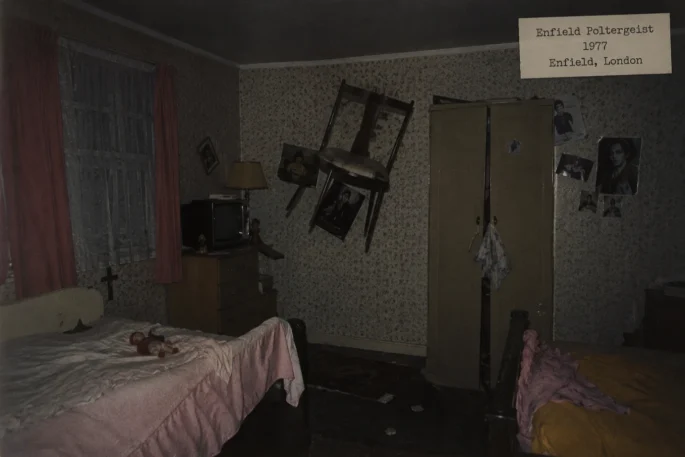
The Enfield Poltergeist case stands as one of the most heavily documented and fiercely debated paranormal events in modern history. Frequently highlighted as a prime example of genuine supernatural activity, it even served as the main inspiration for Hollywood’s blockbuster horror film, The Conjuring 2.
But when you strip away the cinematic jump scares and look purely at the historical record, what actually happened?
By analyzing the original 1970s timeline, official police logs, and the arguments presented by contemporary skeptics, we can piece together a fascinating, data-driven look at the haunting that terrified London.
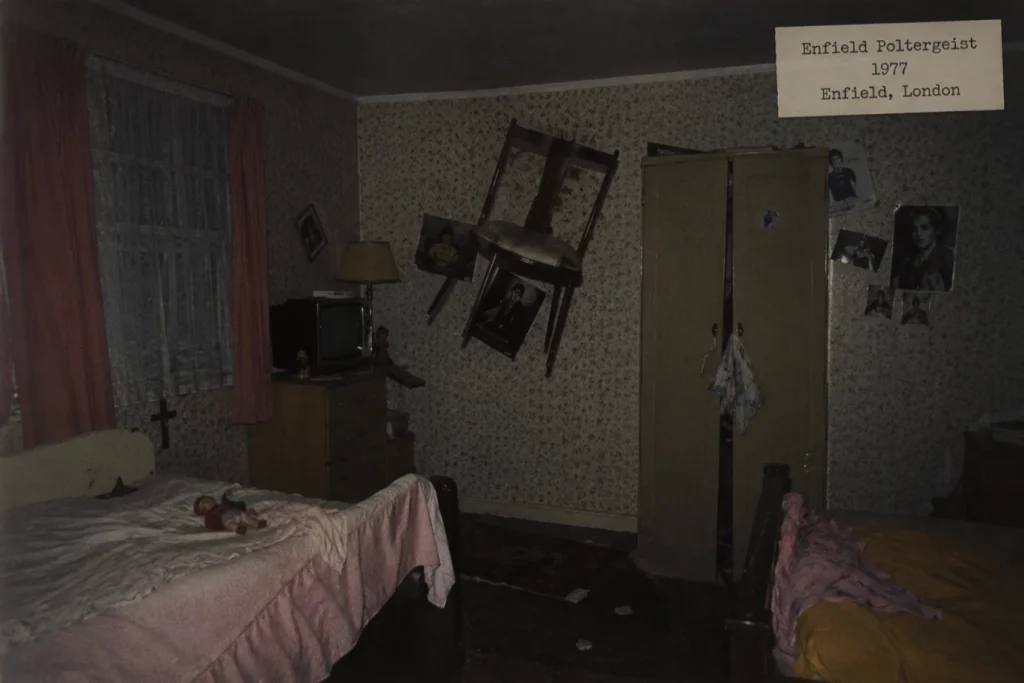
The Historical Timeline: How the Terror Unfolded
The disturbances took place within a modest council house at 284 Green Street in Enfield, North London, home to single mother Peggy Hodgson and her four children: Margaret, Janet, Johnny, and Billy.
August 1977: The Spark
The phenomenon officially ignited on August 30, 1977. Peggy Hodgson reported that furniture was sliding across rooms completely on its own, accompanied by loud, rhythmic banging noises vibrating through the walls. Shortly after, young Janet Hodgson claimed her bed was violently moving. While the family initially tried to dismiss the anomalies, the escalating activity quickly convinced them that something unexplainable was in their home.
September 1977: The Authorities Step In
On September 3, 1977, local police arrived at the home after a neighbor reported hearing the children screaming. Recognizing that this was no ordinary disturbance, paranormal researchers Maurice Grosse and Guy Lyon Playfair from the Society for Psychical Research (SPR) arrived on the scene to document the events.
October – December 1977: The Peak Activity
Throughout autumn, the haunting reached a chaotic peak, with 11-year-old Janet positioned squarely at the center of the vortex. Witnesses recorded Janet speaking in a deep, gravelly voice that did not belong to a child, and multiple accounts emerged of Janet being thrown from her bed or completely levitating in mid-air. By the end of 1977, the house was under constant media and paranormal scrutiny.
1978 – 1979: The Decline
Investigations slowly continued into 1979. Over time, the frequency of the incidents began to sharply decline, the media circus waned, and the intensity eventually diminished entirely by the mid-1980s.
The Evidence: Official Police Reports and Testimonies
What separates the Enfield case from typical ghost stories is the involvement of objective, third-party professionals. Law enforcement officials were among the very first to witness the activity firsthand, providing a rare layer of credibility to the narrative.
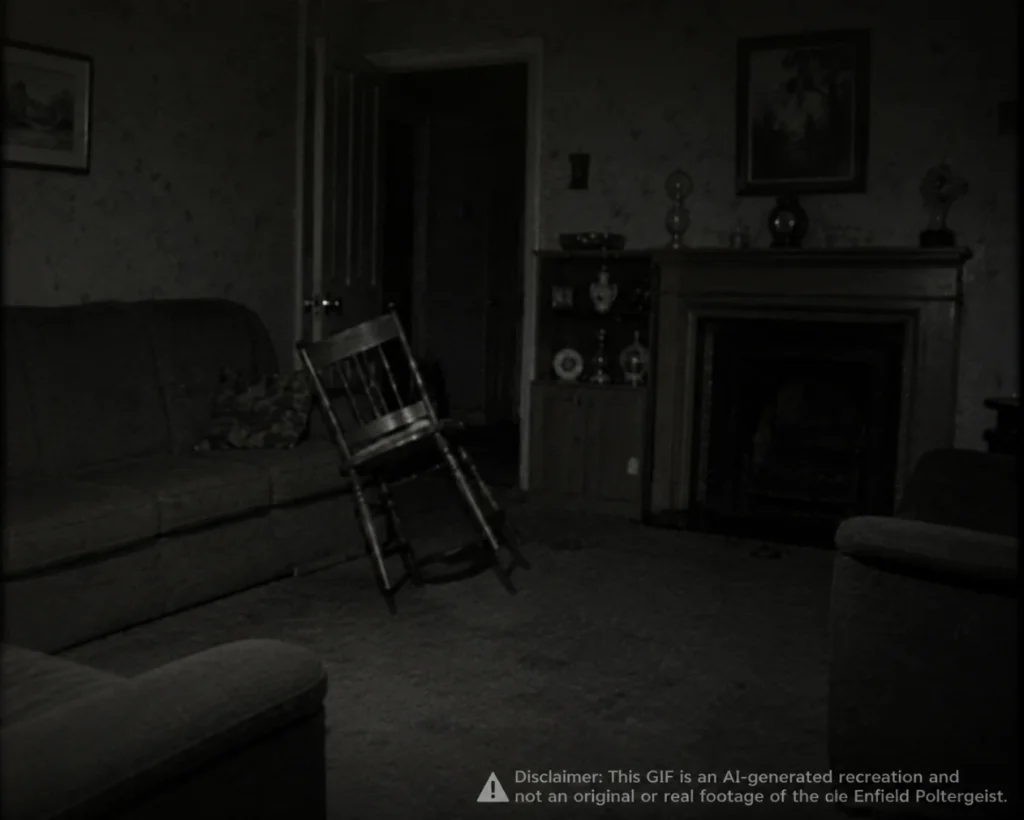
- The Moving Chair: In an official written statement, Police Constable Kenneth McKenzie noted that he personally witnessed a chair levitate and slide across the room with no physical explanation.
- Unexplained Audio: Multiple responding officers logged reports of unexplained knocking and thumping sounds coming from the structure of the house, while the children were fully accounted for.
While these reports strongly supported the family’s claims, over time, even some of the involved officers found it incredibly difficult to reconcile their personal experiences with rational science, fueling the ongoing debate.
The Skeptic’s Lens: Hoax or Collective Hysteria?
Despite the mountain of eyewitness accounts, a heavy amount of skepticism surrounds Enfield. Critics and investigators have raised several compelling, non-supernatural explanations for what occurred at Green Street:
1. Severe Family Dysfunction
Psychologists argue that the entire event could be a manifestation of intense psychological stress. The Hodgson family was dealing with the sudden, abrupt separation of the parents. Skeptics suggest the children may have channeled this emotional trauma into collective behavioral manifestations that were easily misconstrued as paranormal phenomena.
2. Attention-Seeking Fabrications
Because Janet was the primary focal point of the activity, critics point out that a young child could easily be influenced by the massive wave of media attention. Famous skeptics and magicians, such as James Randi, argued that the children staged the tricks—like throwing toys or throwing themselves off beds—to gain notoriety, sympathy, and monetary support. Janet herself later admitted that they did fake “one or two” incidents just to see if the investigators would catch them.
3. A Lack of Verification
From a data-driven perspective, the evidence lacks scientific validation. Most of the famous photographs of Janet “levitating” look suspiciously like a child simply jumping off a bed. Critics maintain that without airtight, verifiable laboratory controls, the recordings and photographs remain purely anecdotal and open to human interpretation.
The Lasting Legacy
| The Case for the Supernatural | The Case for a Hoax |
| Firsthand written testimonies from police officers. | The children admitted to faking a small percentage of the events. |
| Independent audio recordings of the “entity” speaking through Janet. | Phenomena closely aligned with family trauma and parental separation. |
| Consistent tracking by the Society for Psychical Research. | Photographic evidence could easily be interpreted as a child jumping. |
When the family eventually moved away from the house, the hauntings stopped completely. Whether the entities were tied to the environment, tied to Janet’s adolescence, or simply a beautifully orchestrated prank, the tension between rationality and the unexplained is what keeps this mystery alive.
Decades later, the Enfield Poltergeist remains the ultimate litmus test for paranormal believers and skeptics alike.
What do you think? Was 284 Green Street a genuine gateway to the supernatural, or was it the ultimate psychological cry for help from a fractured family? Let us know your theories in the comments section below!