


Rats are historically stereotyped as aggressive, bold pests. However, anyone who encounters them—whether as a wildlife control professional, a homeowner, or a pet enthusiast—quickly realizes that their actual behavior is much more complex.
When analyzing their survival instincts, the primary question that arises is: Are rats afraid of humans? The short answer is yes—wild rats possess a profound, instinctive fear of humans. To them, we are massive, unpredictable apex predators. However, a rat’s fear response is highly dynamic, dictated by evolutionary biology, environmental context, and its level of domestication.
This guide breaks down the behavioral science behind rodent psychology, how wild vs. domesticated responses differ, and what to do during an encounter.
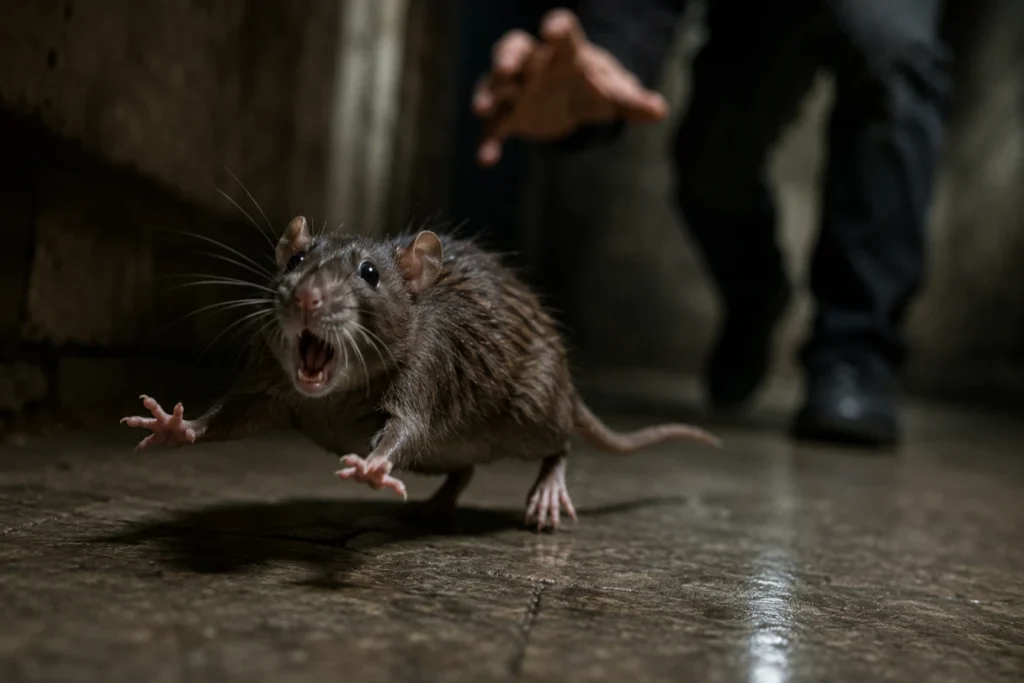
The Evolutionary Biology: Why Are Rats Afraid of Humans?
Fear is an evolutionary survival mechanism that keeps rodents alive. Because rats are low on the food chain, their brains are hardwired to treat any larger moving creature as an immediate threat.
1. Instinctive Fear (The Amygdala Response)
Rats possess an innate wariness known as neophobia (fear of the new or unfamiliar). When a wild rat encounters a human, its sympathetic nervous system immediately spikes. Its primary directive is self-preservation, which translates to a “flight” response—seeking a dark hiding spot, a drainpipe, or a burrow to escape visual contact.
2. Learned Behavior and Memory
Rats possess highly developed cognitive maps and spatial memory. If a rat experiences a negative encounter with a human (such as being chased, stomped at, or caught in an aggressive environment), it encodes that threat deeply. Conversely, if a wild rat consistently finds food near human habitations without facing danger, its fear barrier slowly degrades through a process called habituation.
Wild Rats vs. Domesticated Pet Rats: The Behavioral Divide
To accurately answer whether rats are afraid of humans, it is impossible to ignore the distinct genetic line between wild populations and domesticated “fancy” rats.
| Behavioral Metric | Wild Rats (Rattus norvegicus / rattus) | Domesticated Fancy Rats (Rattus norvegicus domestica) |
| Primary Instinct | Extreme flight or defensive fight. High neophobia. | Intense curiosity, social orientation, low neophobia. |
| Human Association | Humans = Predators or passive food providers. | Humans = Safety, companionship, and treats. |
| Biting Tendency | Will bite only if cornered, trapped, or protecting a nest. | Extremely rare; typically only bite if accidentally hurt or provoked. |
| Social Communication | Uses ultrasonic distress calls and alarm pheromones to warn the colony. | Uses complex vocalizations, social grooming, and playful “bruxing” (teeth chattering). |
4 Variables Altering a Rat’s Fear Response
While a rat’s default setting around humans is avoidance, specific variables can cause them to act bold or indifferent:
1. Environmental Control and Territory
A rat in its own established nesting territory feels a heightened sense of confidence. If a human corners a wild rat inside a tight crawlspace, closet, or dead-end alley, the flight instinct becomes impossible. The rat will instantly pivot to a desperate defensive fight response, which can include lunging, squeaking loudly, or biting.
2. Urban Adaptation
In heavily populated metropolitan areas, wild rats encounter thousands of humans daily. Over generations, these urban populations undergo behavioral adaptation. They learn that humans move predictably along sidewalks and rarely pose a direct threat unless provoked. This creates an illusion of boldness, though it is actually highly calculated tolerance driven by the pursuit of food.
3. Starvation and Resource Scarcity
A starving animal is a desperate animal. If a rat colony’s primary food source is cut off, their survival drive will completely override their instinctive fear of humans. They will forage during daylight hours and closely approach human spaces, ignoring risks they would normally avoid.
4. Pheromonal Colony Communication
Rats are apex communicators within their social hierarchies. If a scout rat detects an aggressive human, it releases specific stress pheromones and high-frequency vocalizations. This immediately triggers a collective, heightened fear state across the entire local group, causing all surrounding rats to vanish into hiding.
What to Do During a Wild Rat Encounter
If you suddenly find yourself face-to-face with a wild rat in your home, garage, or yard, follow these steps to avoid triggering an aggressive defensive reaction:
- Create a Clear Escape Route: Never step directly between a rat and its nearest visible exit point. Ensure the animal has a clear, unblocked path to flee.
- Avoid Sudden, Stomping Movements: Erratic gestures or loud noises activate their predatory threat triggers, causing them to bolt frantically, which may cause them to accidentally run toward you.
- Do Not Attempt to Corner or Touch: A wild rat will not seek out a fight with a human, but it will strike back with surgical precision if it feels physically trapped.
- Back Away Calmly: Stand still or take slow, deliberate steps backward. Once the rat registers that you are giving it space, it will quickly look for a way out.
Frequently Asked Questions (FAQ)
Are rats afraid of humans when they are asleep?
Rats retain their fear of humans regardless of whether the person is awake or asleep. Wild rats do not actively hunt or attack humans. However, if a home has a severe infestation and a person sleeps in an area where food residue or crumbs are present on the bedding, a foraging rat may climb onto the bed. If the sleeping person rolls over and accidentally pins or startles the rat, the animal will bite out of pure defensive panic.
Why do some wild rats look at you and stand still instead of running?
When a rat freezes upon seeing you, it is executing a classic prey-animal survival strategy. Its vision is optimized for detecting movement rather than sharp detail. By freezing, it is assessing whether you have actually spotted it, while simultaneously calculating the fastest, safest route to nearby cover.
Can a wild rat be tamed out of its fear?
While a young wild rat pup can occasionally be habituated to human touch through intense, dedicated socialization, it is highly discouraged. Wild rats carry distinct wild genetics and potential pathogens that make them unsuited for domestic life. If you want a pet rat, always adopt a domesticated fancy rat from a reputable breeder or rescue.
Disclaimer: While domesticated pet rats are incredibly safe and clean companion animals, wild rats can carry zoonotic diseases. If you have a wild rodent infestation in your home, consult a licensed pest management professional to handle exclusion and eradication safely.